What makes a good PE lesson? Guidance for the new term
What makes a good PE lesson? A clear purpose, active pupils and the right level of challenge can help every child enjoy PE and make progress.

What makes a good PE lesson? Ask a group of teachers and you will probably get a few different answers. Lots of activity? Children having fun? Clear progress? In truth, a good lesson needs a balance of all three.
At PE Planning, we create PE lesson plans for busy primary school teachers. Many of the teachers using our resources are not PE specialists—and they shouldn’t need to be. With a clear plan, a few simple teaching points and activities that suit the class, every teacher can deliver a PE lesson that makes a difference.
So, as the new term gets underway, here is our honest guide to what works.
What makes a good PE lesson
A good PE lesson should be active, enjoyable and focused on learning. Children don’t need to perform every skill perfectly, and the lesson doesn’t need lots of specialist equipment or complicated activities. What matters is that pupils know what they are working on, have plenty of opportunities to practise and finish the lesson having moved forward in some way.
For us, the essentials are:
- a clear learning objective
- simple explanations and teaching points
- plenty of time for children to be active – ‘maximum class activity’
- appropriate challenge for all your pupils
- opportunities to practise, receive feedback and try again – ‘maximum pupil learning’
- a positive environment where every child feels able to join in
That doesn’t mean every lesson will run exactly as planned. PE rarely works like that! Sometimes an activity takes longer than expected, the groups don’t work, or a task that looked perfect on paper is too easy or too difficult. Good PE teaching is often about spotting this quickly and making a small change
Make the lesson purpose clear to pupils
Your lesson plan gives you the learning objective; the important next step is making it meaningful to the children. At the beginning of the lesson, briefly explain what they will be learning and what success might look like. Keep the language simple and relevant to the activity so pupils know what to focus on without spending too long standing and listening.
Return to the objective throughout the lesson. Remind pupils of the focus before a new activity, use demonstrations to highlight the key teaching points and pause briefly when there is something useful for the class to notice. A quick prompt such as, “Remember, today we are working on control—what could help you here?” can bring their attention back to the learning without interrupting the flow of the lesson.
Finish with a short recap. Ask pupils what they have learnt, what helped them improve and what they might try next time. This helps children recognise their own progress and gives you another opportunity to check their understanding.
Keep children active – but make the activity count
We all want children to be active during PE. However, lots of movement doesn’t automatically mean lots of learning. A game can be great fun and still miss the purpose of the lesson if pupils don’t know what they are trying to improve.
Try to keep explanations short, use pairs or small groups and avoid long queues wherever possible. If you have enough equipment, let more than one group work at the same time. Small-sided games are usually more useful than one large game where confident pupils dominate and others barely touch the ball.
It also helps to avoid elimination games where children sit out after making a mistake. Usually, those are the pupils who would benefit most from staying involved and having another go.
The aim is simple: keep waiting time down and give every child repeated opportunities to practise the skill.
Don’t overload pupils with teaching points
One or two clear teaching points are usually enough to begin with. You can always add more once the children are confident.
A quick demonstration often works better than a lengthy explanation. You can demonstrate yourself, ask a pupil to help, or show one part of the skill at a time. Give the class something specific to watch for: Where are the feet positioned? What happens to the ball? Where is the performer looking?
As pupils practise, use short questions to check understanding:
- What helped you stay in control?
- How could you create more space?
- What changed when you slowed the movement down?
- Which approach worked best for you?
You don’t need to stop the whole class every time you notice something. Often, a quick comment to an individual or group will be enough.
And when you give feedback, give pupils time to use it. “Keep the ball closer to your feet and try again” is much more useful than feedback given just as the activity ends.
Adapt the PE lesson for the class in front of you
Every class is different. Within the same group, you may have children who attend sports clubs several times a week, children who are still developing basic movement skills and children who lack confidence in PE.
You don’t need a separate activity for every pupil. Small adaptations to the activities within your PE Planning lesson can make them accessible and appropriately challenging for more children.
You could change the size of the area, the distance between pupils, the amount of time available or the type of equipment being used. A larger, softer ball might help a pupil build confidence with catching. A smaller target, greater distance or added defender might challenge someone who is ready to progress.
Try not to think of adaptation as simply making an activity easier. It is about giving each pupil a suitable starting point and a realistic next step.
Create the right enviroment for PE
Children are far more likely to take part and try something new when PE feels safe, positive and well organised.
Clear routines make a big difference. Pupils should know how to find a safe space, collect and return equipment, respond to your signal and stop to listen. These may sound like small things, but they protect learning time and make lessons much easier to manage.
Safety checks are important too. Check the space and equipment before the lesson, consider the weather and surface, and make sure pupils have suitable clothing and footwear. However, safety isn’t only physical. Think about how teams are chosen, how mistakes are handled and whether less confident children feel supported rather than exposed.
Praise effort, improvement, teamwork and sportsmanship—not just the fastest runner or the pupil who scores the most goals. This helps children understand that success in PE can look different for everyone.
Make every PE lesson count
The first lesson of a new term is a brilliant opportunity to get to know your class, set boundaries and create some excitement about PE. Taking time to establish expectations now can save a lot of repeated reminders later in the year.
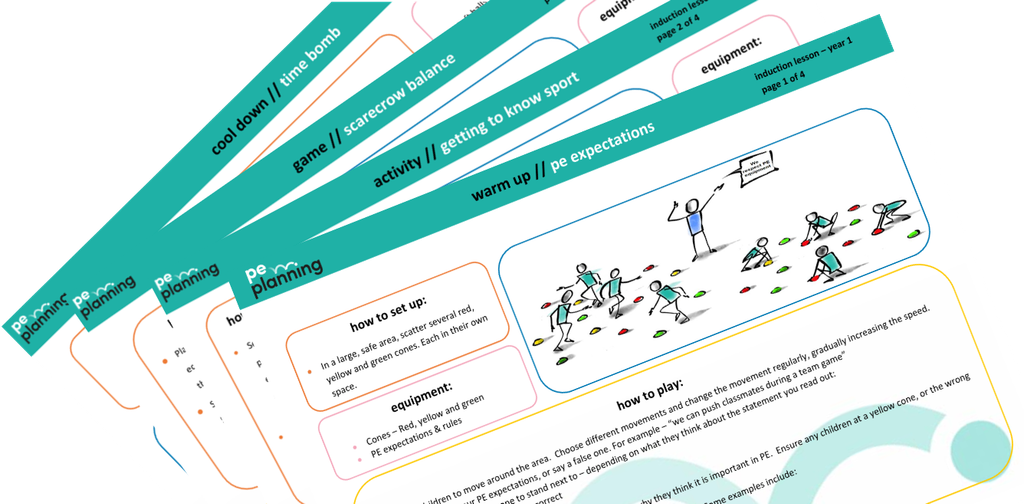
We have created free PE Rules and Expectations lessons for EYFS through to Year 6. They aren’t sit-down lessons about rules. The children are active, playing games and completing challenges while learning how to use space and equipment safely, respond to instructions and work well with others.
The activities also encourage pupils to share what they enjoy, what they want to learn and what they expect from PE. This gives you a chance to learn more about your new class while building their motivation for the term ahead.
All seven lessons are currently unlocked and free to access. They are ideal for the first week, but you can also return to them whenever a class needs a reminder about PE routines, teamwork or sportsmanship.

Check pupil learning
Assessment in PE doesn’t need to mean standing at the side with a clipboard for the whole lesson. Much of it happens through watching pupils, listening to their answers and asking a few useful questions.
Can pupils explain the main teaching point? Can they show the skill with a little more control than they could at the start? Can they use it in a game, sequence or more challenging activity?
Those quick observations help you decide whether to move on, revisit something or adapt the task. They also give you useful information for the next lesson and your end-of-unit judgements.
What makes an outstanding PE lesson?
What makes an outstanding PE lesson? In our opinion, it isn’t a lesson that looks like a coaching masterclass or one in which everything goes perfectly.
It is a lesson where pupils understand what they are learning, spend plenty of time purposefully active and receive the support or challenge they need. The teacher notices what is happening, asks useful questions and isn’t afraid to change an activity when it isn’t working.
You should be able to see pupils improving—whether that means performing a skill with more control, making better decisions, working more effectively with others or simply joining in with greater confidence.
Most importantly, an outstanding lesson works for that particular class. Following a plan word for word is never more important than responding to the children in front of you.
A simple structure to follow
PE Planning lessons already follow a clear structure. As you deliver the lesson, these are the main stages to keep in mind:
- Introduce the focus. Tell pupils what they are learning and why it matters.
- Warm up. Prepare them physically and, where possible, link the activity to the main lesson.
- Develop the skill. Demonstrate, share a small number of teaching points and allow plenty of practice.
- Apply the learning. Use a challenge, performance, sequence or small-sided game.
- Review. Bring pupils together briefly to discuss what improved, what helped and what they need to work on next.
Your timings will change depending on the class and activity. That is fine. The important thing is that the main learning doesn’t get squeezed into the final few minutes because the introduction or warm-up ran for too long.
A final thought for the new term
PE can be one of the most rewarding lessons to teach. It gives children the chance to move, solve problems, work with different classmates and experience success away from their desks.
When thinking about what makes a good PE lesson, come back to the basics: know what you want pupils to learn, keep them active, make the teaching points clear and adapt when something isn’t working.
You don’t need to be a sports expert, and every lesson certainly doesn’t need to be perfect. A clear plan, good routines and a willingness to respond to your pupils will take you a long way.
At PE Planning, we want to make that process easier. We provide the structure, activities and subject knowledge, leaving you free to focus on your class and help every pupil enjoy making progress in PE. If you need any help with your PE lessons or using our resources, please get in touch. We are always happy to help and love talking anything PE!