PE Assessment in Primary School: Why It Matters and How to Get It Right
Assessment is an important part of teaching, but in primary school PE, it can sometimes feel like an additional challenge. How do we accurately assess pupils' physical development, knowledge and understanding while keeping lessons active, enjoyable and inclusive?

Assessment is an important part of teaching, but in primary school PE, it can sometimes feel like an additional challenge. How do we accurately assess pupils’ physical development, knowledge and understanding while keeping lessons active, enjoyable and inclusive?
At PE Planning, we’re passionate about helping primary schools deliver high-quality, inclusive and progressive PE.
We believe assessment should be a natural part of teaching, helping teachers recognise pupil progress, identify gaps in learning and make informed decisions about what to teach next.
The good news is that effective PE assessment doesn’t need to be complicated or time-consuming.
So, what should schools assess, what do Ofsted and the Department for Education expect, and how can teachers make assessment work in practice?
Is assessment in primary school PE really necessary?
Unlike English and Maths, primary school PE doesn’t have statutory national tests or a prescribed grading system.
However, that doesn’t mean assessment should be overlooked.
The Department for Education’s National Curriculum for PE expects pupils to develop competence in a broad range of physical activities, become physically confident and develop the knowledge and skills needed to lead healthy, active lives.
By the end of each key stage, pupils should know, apply and understand the matters, skills and processes specified in the relevant programme of study.
But how can teachers establish whether pupils are achieving these outcomes without assessing their learning?
Effective assessment helps teachers understand where pupils are, recognise the progress they are making and identify what they need to learn next.
Importantly, this doesn’t necessarily mean formal testing or completing lengthy assessment records. Much of the most valuable assessment takes place naturally throughout a PE lesson.
What does Ofsted say about PE assessment?
Ofsted’s 2022 PE Research Review and its subsequent 2023 subject report, Levelling the Playing Field, both highlight the importance of meaningful assessment.
Ofsted identifies three interconnected areas of knowledge that contribute to pupils’ development in PE:
- Motor competence: Developing the movement skills and techniques needed to participate confidently in physical activities.
- Rules, strategies and tactics: Understanding how to participate effectively in different sports and physical activities.
- Healthy participation: Developing the knowledge needed to participate safely and effectively in physical activity.
Assessment should help teachers establish how pupils are progressing in these areas, with a particular focus on what they have actually learned.
Ofsted’s research also highlights the importance of assessment being closely linked to the curriculum and used to inform future teaching.
In other words, assessment shouldn’t simply be about recording achievement. It should help improve it.
Ofsted does not prescribe a particular PE assessment system. Schools should choose an approach that supports their curriculum, pupils and teachers.

What are the benefits of assessing pupils in PE?
Recognising individual progress
Every pupil begins their PE journey with different experiences, abilities and levels of confidence.
Some children arrive at school with considerable experience of sport and physical activity, while others may have had fewer opportunities to develop fundamental movement skills.
Assessment helps teachers recognise these different starting points and, importantly, the progress each child makes.
A pupil who initially struggles to catch a ball but develops the confidence and technique to catch consistently has made significant progress, even if other pupils are already performing more complex skills.
Recognising and celebrating that development is an important part of creating a positive PE experience.
Identifying gaps in learning
Assessment can help teachers recognise when pupils haven’t fully developed the skills or understanding needed to progress.
For example, a class learning to play netball may understand the rules of passing but struggle to demonstrate an accurate chest pass.
Recognising this allows the teacher to revisit the technique, provide additional practice and adapt activities before introducing more complex challenges.
Without assessment, there’s a risk of moving through the curriculum without ensuring pupils have secured the foundations they need.

Supporting inclusion and differentiation
An effective PE curriculum should provide appropriate challenges and opportunities for every pupil to succeed.
Assessment helps teachers understand individual needs and adapt activities accordingly.
This might involve changing the equipment, adjusting the playing area, providing additional support or introducing greater challenges.
For pupils with special educational needs and disabilities (SEND), assessment should recognise individual starting points and provide meaningful opportunities to demonstrate progress, without unnecessarily limiting expectations.
Improving curriculum planning
Assessment isn’t just valuable for individual pupils. It can also provide useful information about the effectiveness of a school’s wider PE curriculum.
For example, if assessments consistently identify weaknesses in balance, coordination or fundamental movement skills across several year groups, this may indicate a need to revisit curriculum content or sequencing.
Likewise, identifying areas of strength can help subject leaders understand which aspects of their PE provision are working particularly well.
Over time, assessment information can help schools make informed decisions about curriculum development, staff training and future priorities.
Demonstrating progress across the school
PE subject leaders are often asked to explain how their curriculum supports progression from EYFS through to Year 6.
A consistent approach to assessment can help provide this evidence.
By identifying intended learning outcomes and reviewing pupils’ achievements, schools can develop a clearer picture of what children are learning as they progress through their primary education.
This can support conversations between teachers, subject leaders, senior leadership teams and parents.
However, the purpose should always remain improving learning, rather than simply producing reports.
How can schools make PE assessment manageable?
One of the biggest challenges facing primary teachers is time.
PE lessons are active, practical and often delivered in busy environments. Teachers need to manage equipment, organise activities, support pupils and maintain engagement.
Adding complicated assessment procedures can quickly become counterproductive.
At PE Planning, we believe the best approach is to make assessment a natural part of every lesson, rather than something teachers need to do separately.
That’s why we’ve embedded opportunities for assessment throughout our lesson plans.
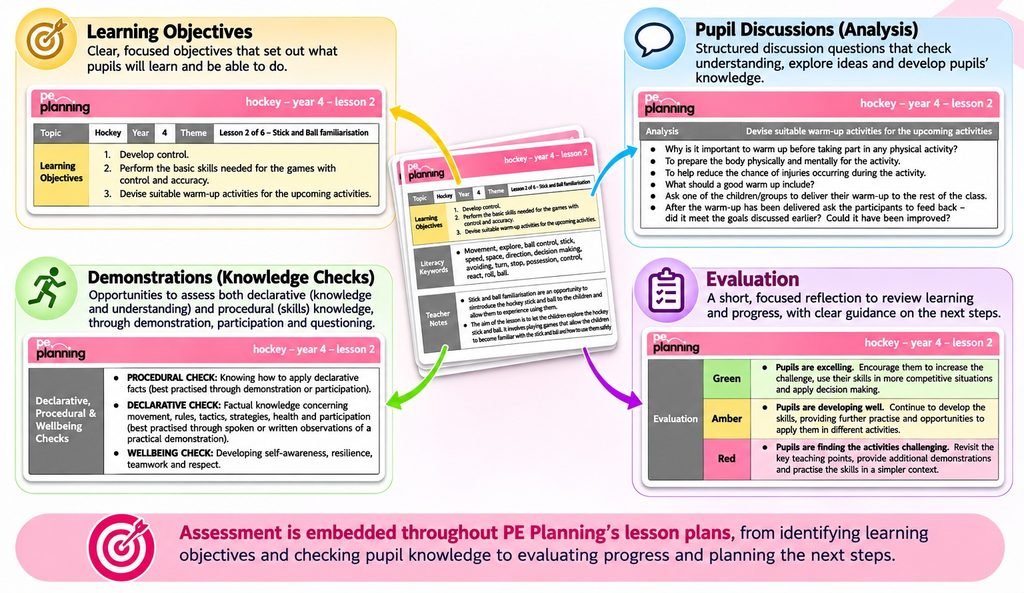
For example, our Year 4 Hockey lesson demonstrates four important elements of effective assessment.
1. Learning Objectives – Knowing what pupils should learn
Every PE Planning lesson begins with clear learning objectives, identifying the intended knowledge and skills.
In our Year 4 Hockey lesson, these include developing control, performing basic skills accurately and devising suitable warm-up activities.
These objectives give teachers a clear focus for observing pupil performance and recognising progress.
2. Pupil Discussions (Analysis) – Checking understanding
Our lesson plans include structured questions and opportunities for discussion, helping teachers establish what pupils know and understand.
For example, during the hockey warm-up, pupils are asked why warming up is important and what a suitable warm-up should include.
They’re then challenged to devise their own warm-up activities and evaluate whether those activities meet the intended goals.
These discussions provide valuable Insight into pupils’ understanding without requiring separate written assessments.
3. Demonstrations (Knowledge Checks) – Showing what pupils know and can do
Throughout our lessons, Knowledge Checks encourage teachers to assess both declarative and procedural knowledge.
Declarative knowledge relates to what pupils know and understand, such as techniques, rules, tactics and strategies.
Procedural knowledge relates to what pupils can do and how they apply their knowledge through movement and practical performance.
For example, during a hockey dribbling activity, teachers might ask some pupils to demonstrate the correct technique while others explain what is required to perform the skill successfully.
This provides opportunities to assess both practical competence and understanding during the lesson itself.
Our plans also encourage teachers to consider wellbeing, including teamwork, resilience and respect.
4. Evaluation – Using assessment to inform the next lesson
At the end of every PE Planning lesson, teachers are encouraged to evaluate how pupils are progressing.
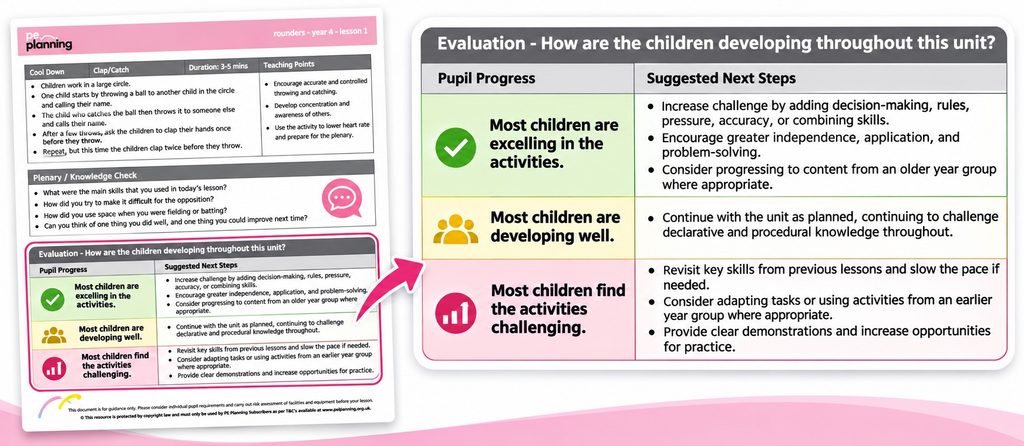
Our simple evaluation framework helps teachers consider whether most pupils are excelling, developing well or finding activities challenging.
Crucially, it also suggests what to do next.
Where pupils are excelling, teachers might increase the challenge or introduce greater opportunities for decision-making and problem-solving.
Where pupils are developing well, teachers can continue with the planned progression.
And where pupils are finding activities challenging, teachers might revisit earlier skills, adapt activities or provide additional demonstrations and practice.
This is assessment at its most valuable: using what teachers observe to make the next lesson even better.

Keeping assessment practical
By incorporating learning objectives, pupil discussions, demonstrations and evaluation into our lesson plans, we aim to make assessment straightforward and manageable.
Teachers can observe, question and evaluate pupils as they participate in activities, without unnecessarily interrupting learning or reducing physical activity time.
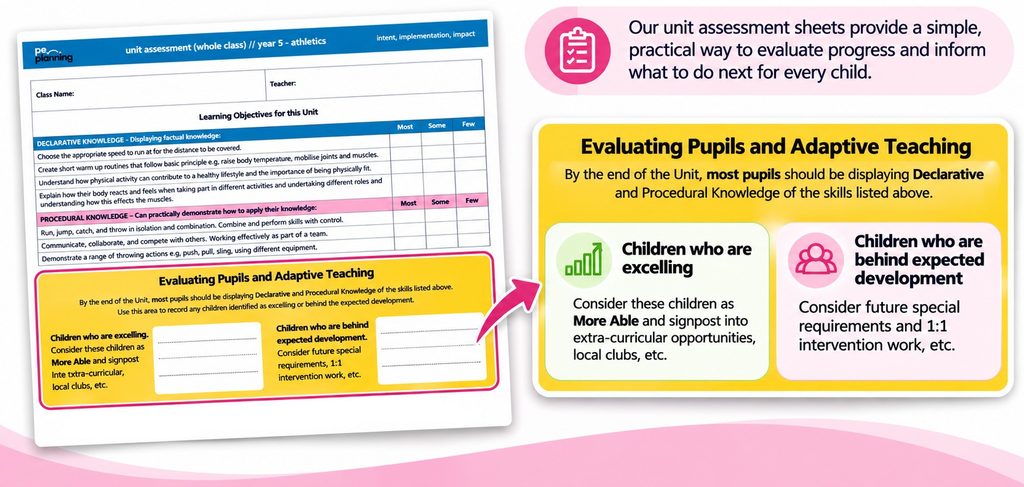
Of course, schools may also wish to record pupil achievements and monitor progress across a unit of work or the wider curriculum.
That’s where our online assessment system can help.
Recording and tracking pupil progress with PE Planning
Alongside our curriculum resources, PE Planning provides an online pupil assessment tool.
This allows teachers to record pupil assessments against our curriculum learning outcomes and review progress over time.
The system supports a consistent approach to PE assessment across the school, helping teachers and subject leaders identify individual achievements, areas for development and wider curriculum priorities.
For schools already using PE Planning, our assessment tool remains available as part of our existing provision.
However, we’re also delighted to offer schools an additional option through our new partnership with Insight.
Introducing our new partnership with Insight
We’re delighted to announce our partnership with Insight, an established online pupil assessment and tracking platform used by thousands of schools.
Through this partnership, our PE assessment statements are now available within Insight.
This means schools that subscribe to both PE Planning and Insight can assess pupils against our curriculum outcomes directly within their existing Insight platform, alongside assessment information from other subjects.
For our existing subscribers, nothing needs to change.
Schools can continue to use PE Planning’s own online assessment system, or choose to record their PE assessments within Insight.
We believe this flexibility is an important step towards making PE assessment easier and more accessible for primary schools.
By bringing together our specialist PE curriculum resources and Insight’s whole-school assessment platform, we hope to help more teachers assess pupil progress confidently and consistently.
Assessment should support learning, not create more work
Ultimately, the purpose of assessment in primary school PE is simple: to help every child make progress.
When teachers understand what pupils have learned, what they can demonstrate and where they need additional support, they are better equipped to deliver engaging, inclusive and progressive lessons.
Assessment also gives PE subject leaders valuable Insight into the effectiveness of their curriculum, helping schools continually review and improve their provision.
Whether schools choose to assess through PE Planning, Insight or another suitable approach, the most important consideration is that assessment remains meaningful, manageable and focused on improving outcomes for pupils.
Because in PE, success isn’t simply about how well a child performs today. It’s about helping every child develop the competence, confidence and knowledge to enjoy being active throughout their lives.
Discover our online assessment tool
See how PE Planning helps teachers record pupil assessments and monitor progress: Explore PE Planning’s online assessment system.
Find out more about Insight. Learn more about our new pupil tracking partner: Visit Insight.